You can use Claude or ChatGPT with GetLeads to turn an ideal customer profile into a checked lead list - not an automatic email campaign. Start by connecting through MCP or the API, run a free count, and test a search with 5 contacts before you pull more.
Here’s the workflow:
- Define the target: Separate required filters from preferences, and confirm which fields GetLeads supports.
- Connect and test: Use MCP for interactive searches or the API for scripts. Store credentials safely and check results, errors, and usage.
- Enrich and audit: Fill data gaps, verify emails, remove duplicates, and flag uncertain matches without guessing.
- Export for review: Keep ICP fit separate from outreach eligibility, apply suppression and consent checks, and set the next batch’s size.
Counts and field lists are free. One credit buys one returned record, so the small test uses 5 credits plus 1 for the enrichment on a credit-based plan. On an unlimited plan it counts toward your fair-use budget instead. The rule before launch is simple: a verified email is not permission to send. Human approval comes before any campaign.
1. Connect Claude or ChatGPT to GetLeads
With your ICP and fields ready, you can connect Claude or ChatGPT to GetLeads.
Choose MCP or API Access
Use MCP for interactive research and the REST API for scripts and recurring jobs. Every new account gets 1,000 free exports, and counting how many results a search would return is always free. See pricing for the plans.
| Setup detail | MCP | REST API |
|---|---|---|
| Setup effort | Add a remote connector and sign in | Build and maintain request handling |
| Best use case | Interactive lead research | High-volume automation and recurring jobs |
Choose your connection type, set up access, and send a test request to check that it works.
Set Up the Remote MCP Connection
In Claude, go to Settings > Connectors > Add custom connector, name it GetLeads and paste https://app.getleads.io/api/mcp. Connect, sign in to GetLeads and approve access. The connection is remote, so you don’t need a local installation or proxy, and you don’t need an API key for this sign-in flow.
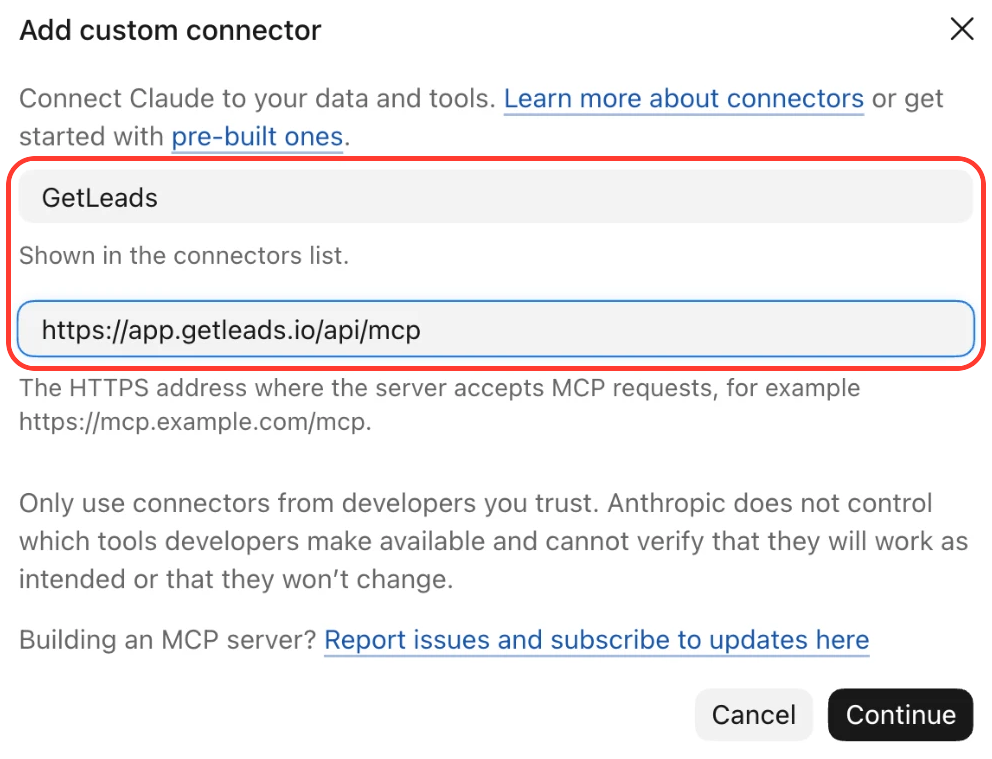
In ChatGPT, open the connector settings and add a custom MCP connector with the same URL, https://app.getleads.io/api/mcp. Choose OAuth or sign-in authentication, then sign in to GetLeads and approve access before running your first prompt. The MCP page has a set-up button and instructions for other clients.
Set Up API Requests and Store Credentials
Create an API key at app.getleads.io/api-keys. Store it in an environment variable or secret manager, not in prompts or source control. Have your script read the secret and send it using Authorization: Bearer ... or X-API-Key. Retrieve field definitions with GET /api/v1/contacts/columns, then map the responses to your existing lead schema. The API docs cover every endpoint.
Set up pagination, retries, and rate limits before scheduling jobs. REST search supports limit and offset, with up to 5,000 rows per page. Pass the returned next_offset and stop when has_more is false. The default rate limit is 100 requests per minute per account, so honor Retry-After when you receive a 429 response.
2. Test the Connection and Search for Leads
Test Tools, Filters, and Enrichment
Before testing searches, confirm that the connection is active in your client. Run get_fair_use to see your account’s budget, then use get_available_columns and get_available_values to check filter names and accepted values. Ask the assistant to list the available tools and their accepted inputs. Check that the tools, filters, and enrichment return the records you expect.
Run count_contacts before testing search_contacts with a 5-result limit. Check literal filter matching: “Engineer” does not automatically match “Engineering.” Make sure the returned fields match your export schema, especially LinkedIn URL, work email, title, seniority, and company domain.
Next, enrich one known contact using their LinkedIn URL with getleads_enrich_person_batch, and check your usage. Five returned contacts and one matched enrichment use 6 records. A genuine no-match should not use a credit. Record the applied filters, missing fields, duplicates, partial matches, and actual usage. Use those same verified filters in your first live search.
Write Prompts for Targeted Lead Searches
Separate required criteria from ranking preferences. For company-level requirements, such as size or technology stack, qualify companies first, then find contacts. The employee_profiles_on_linkedin_min/max fields count LinkedIn employee profiles - not verified total headcount. Use employees_min/max for headcount bands.
Once you’ve confirmed the filters, use this targeted prompt for the full search:
Find 5 CMO contacts at U.S.-headquartered companies with 50–200 LinkedIn employee profiles and Salesforce in the tech stack. Keep company HQ separate from prospect location, rank complete matches above partial ones, and report applied filters, unsupported criteria, duplicates, and partial matches separately.
Fix Connection Errors and Review Weak Matches
If a request fails, read the status code: 401 = missing or invalid API key, 400 = invalid inputs or unsupported filter, 402 = plan-credit or fair-use budget reached, 429 = rate limit. Over MCP, also check isError in the tool result, because some tool errors arrive inside a 200 response.
For empty or inconsistent results, recheck supported values and title matching before suggesting broader criteria. Missing fields mean missing data, not a broken connection. Keep partial matches separate. For verified emails, accept only VALID, not CATCH_ALL or UNKNOWN.
Stop when you reach your budget or get a 402 error. Report the message instead of retrying. Keep the clean matches and move them into enrichment and export.
3. Enrich, Check, and Export Contacts
Enrich Shortlisted Contacts and Check ICP Fit
Send your shortlist to getleads_enrich_person_batch in batches of up to 100 people, using each contact’s LinkedIn URL, work email, or name plus company. For a large CSV, use the upload flow with create_csv_enrichment_upload_link. Each matched record uses one credit, so skip records that already have the data you need. Then standardize the fields for export.
Score icp_fit separately from outreach_eligibility. Compare current_title, seniority_level, is_current_role, company_size, and technologies against your saved ICP. Mark each check verified, unavailable, or uncertain, and keep those labels in the export for a consistent review.
After enrichment, reverify the emails with GetLeads email validation: ask your assistant to quote the job with quote_email_validation, then run start_email_validation. Validation is paid from your prepaid wallet, not plan credits. Keep email_status and email_verified_at, and check each verified field against the saved ICP before exporting.
Email verification alone doesn't approve a contact for outreach. Apply suppression lists, internal exclusions, and applicable consent requirements first. A populated email address - or a strong ICP match - doesn't establish permission to contact someone.
Audit Results and Export a Consistent Lead List
Use this audit prompt before exporting:
Audit the enriched shortlist against the saved ICP. Count contacts by title, seniority, company size, location, and missing required fields. Report duplicates, partial matches, conflicting values, and unverifiable claims. Keep ICP fit separate from outreach eligibility, and flag contacts needing suppression, consent, or internal-exclusion review. Do not fill gaps with guesses.
Export one deduplicated contact per row. Use consistent headers for source values, enriched values, status labels, ICP fit, and outreach eligibility. Include email_verified_at, contact_updated_at, and last_refresh_at where available. Use the current date in summaries and ISO format in exports.
Run count_contacts with your final filters, then export_contacts with confirmed: true and poll check_contact_export until it completes. Each export holds up to 50,000 rows; split larger audiences into separate segments. Use the resulting file as the input for the final outbound-readiness check.
4. Check Readiness for Outbound Review
Before outbound review, check that the exported list matches the saved ICP, uses approved fields and filter values, has no unresolved duplicates, and flags missing or uncertain values. Confirm that the small search-and-enrichment test passed. Run another quick verification search after any credential, filter, or configuration change.
Next, call get_fair_use to check your remaining budget, then set the size of the next batch. Unlimited accounts still have fair-use limits: by default 500,000 rows per day and 6,000,000 per month.
Send the file through outbound review - not straight into a campaign. Move it to launch only after a human reviewer approves the final audience size, subject line, and email body.
FAQs
How often should I refresh my lead list?
Update your lead list regularly and re-verify it before every outreach campaign. People change jobs, and email addresses can stop working. GetLeads profiles are updated monthly. Run the list through GetLeads email validation before each send, and keep only VALID addresses.
How can I improve searches with too few matches?
Broaden your filters by removing restrictions or adding job title variations and related seniority levels. Filters use AND; values within a single filter use OR. Ask your AI assistant to review the available filters and suggest alternatives.
Still getting too few matches? Find companies first with search_companies, then find the relevant people with lookup_decision_makers or search_contacts. Check your changes with the count tool before exporting.
How should I resolve conflicting lead data?
Use enrichment tools to cross-check existing records against updated database information. If you suspect a contact has changed jobs, send their LinkedIn URL, work email, or name and company to getleads_enrich_person_batch. Check is_current_role and role_start_date before relying on an old company association.
For email data, run GetLeads email validation before sending. Stored email addresses can be CATCH_ALL or UNKNOWN, which are not verified.